The Relational Model: Tables, Rows, Columns and Schemas
Tables hold typed columns and unordered rows, schemas hold tables, and every value obeys the type its column declares.
- SQL Basics
- DDL
- DML
- SELECT
- WHERE
- Functions
- NULL and Logic
- Aggregate Functions
- GROUP BY
- JOIN
- Subqueries
- Set Operations
- CTEs
- Constraints
- Keys
- Relationships
- Database Design
- Normalisation
- Views
- Window Functions
- Advanced SQL
- Procedures and Functions
- Triggers
- Temporary Tables
- Transactions
- Isolation and Locking
- Indexes
- Query Performance
- SQL Security
- SQL Dialects
- Practical SQL
Concept
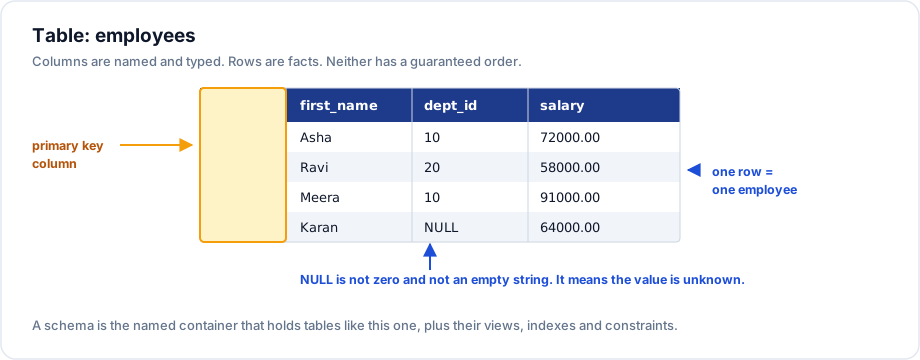
The relational model stores all data in tables (formally, relations). A table has:
- Columns - named and typed. The type is a promise about every value in that column.
- Rows - one fact each. A row in
employeesis one employee. - A key - one or more columns whose value identifies a row uniquely.
Tables live inside a schema, which is a named container for tables, views, indexes and routines. A schema lives inside a database instance.
Syntax
-- MySQL: a schema and a database are the same thing
CREATE DATABASE company;
USE company;

-- PostgreSQL and SQL Server: a schema sits inside a database
CREATE SCHEMA hr;
CREATE TABLE hr.employees ( ... );
Example
CREATE TABLE employees (
    id         INT           PRIMARY KEY,
    first_name VARCHAR(50)   NOT NULL,
    last_name  VARCHAR(50)   NOT NULL,
    dept_id    INT           NULL,
    salary     DECIMAL(10,2) NOT NULL
);

INSERT INTO employees VALUES (1, 'Asha',  'Nair',  10, 72000.00);
INSERT INTO employees VALUES (2, 'Ravi',  'Kumar', 20, 58000.00);
INSERT INTO employees VALUES (4, 'Karan', 'Shah',  NULL, 64000.00);
Explanation
Karan has no dept_id. That is not zero and not an empty string - it is NULL, meaning unknown or not applicable. The column allowed it because it was declared NULL. Had it been NOT NULL, the database would have rejected the row rather than storing a half truth.
Notice also that the rows were inserted as 1, 2, 4. There is no row 3 and there is no guaranteed physical order. The only order that exists in a result is the one ORDER BY creates.
Important rules
- A table is a set: no ordering, no duplicate identity. Duplicate rows are possible unless a key forbids them.
- Every column has exactly one type, and every value in it must fit that type.
- A cell holds one value. Storing
'maths,physics,chemistry'in one column breaks the model and every query that follows. - Schema qualified names (
hr.employees) remove ambiguity when two schemas hold a table with the same name.
Common mistakes
- Designing wide tables with columns like
phone1,phone2,phone3. That is a repeating group; it belongs in a child table. - Assuming
SELECT *returns rows in insert order. It often looks that way on a small table, then changes the day an index is added. - Using
VARCHARfor numbers and dates. You lose type checking, sorting and every date function.
Best practices
- Name tables in the plural (
employees) and columns in the singular (salary). Pick one convention and hold it. - Use
snake_case; it survives every dialect without quoting. - Declare
NOT NULLby default and allowNULLonly where unknown is a real, meaningful state.
Practice
- Sketch a
bookstable with columns for id, title, author, published year and price. Mark which columns should beNOT NULL. - Explain why storing an author list as one comma separated string makes the question how many books did author X write? hard.
- In your own words: what is the difference between a database, a schema and a table?