Recursive CTEs
Query a hierarchy of unknown depth, generate a series of rows, or follow a chain of references - all with one self referencing CTE.
- SQL Basics
- DDL
- DML
- SELECT
- WHERE
- Functions
- NULL and Logic
- Aggregate Functions
- GROUP BY
- JOIN
- Subqueries
- Set Operations
- CTEs
- Constraints
- Keys
- Relationships
- Database Design
- Normalisation
- Views
- Window Functions
- Advanced SQL
- Procedures and Functions
- Triggers
- Temporary Tables
- Transactions
- Isolation and Locking
- Indexes
- Query Performance
- SQL Security
- SQL Dialects
- Practical SQL
Concept
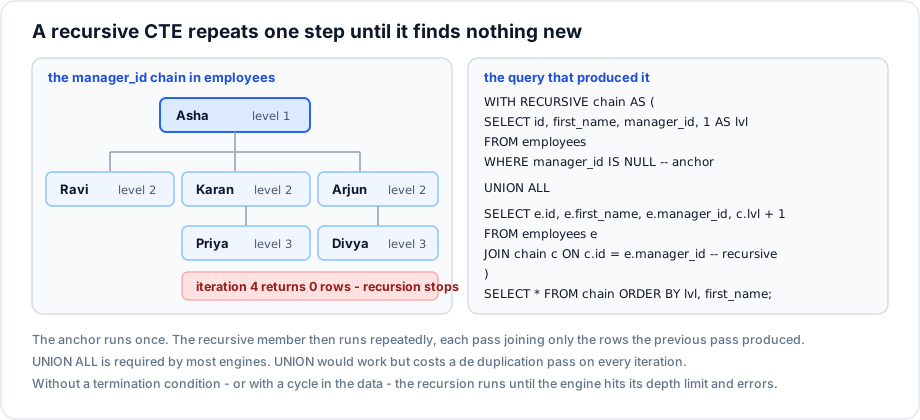
A recursive CTE refers to itself. It has two halves joined by UNION ALL:
- The anchor member - runs once and produces the starting rows.
- The recursive member - joins the CTE to a table, and runs repeatedly. Each pass sees only the rows the previous pass produced.
Recursion stops when a pass returns no rows.
Syntax
WITH RECURSIVE cte_name AS (
    SELECT ...                      -- anchor member
    UNION ALL
    SELECT ... FROM table_name JOIN cte_name ON ...   -- recursive member
)
SELECT * FROM cte_name;
MySQL, MariaDB, PostgreSQL and SQLite require the RECURSIVE keyword. SQL Server and Oracle do not use it - a plain WITH is recursive if it references itself.
Example: an organisation chart
WITH RECURSIVE chain AS (
    -- anchor: the person with no manager
    SELECT id, first_name, manager_id, 1 AS level,
           CAST(first_name AS CHAR(200)) AS path
    FROM   employees
    WHERE  manager_id IS NULL

    UNION ALL

    -- recursive: everyone reporting to a row already in `chain`
    SELECT e.id, e.first_name, e.manager_id, c.level + 1,
           CONCAT(c.path, ' > ', e.first_name)
    FROM   employees e
    JOIN   chain c ON c.id = e.manager_id
)
SELECT level, first_name, path
FROM   chain
ORDER BY level, first_name;
Explanation
The anchor finds Asha, who reports to nobody. Pass one joins employees to that single row and finds everyone whose manager_id is Asha's id. Pass two expands those, and so on. When a pass finds no new reports, the recursion ends.
level and path are built up as the recursion proceeds - each pass adds one to the level and appends a name. The explicit CAST(... AS CHAR(200)) in the anchor matters: the column type is fixed by the anchor, and without it MySQL sizes path to the first name it sees and then truncates every deeper path.
Example: generating a series
-- Every day of January 2024, with no calendar table
WITH RECURSIVE days AS (
    SELECT DATE('2024-01-01') AS d
    UNION ALL
    SELECT DATE_ADD(d, INTERVAL 1 DAY) FROM days WHERE d < '2024-01-31'
)
SELECT d FROM days;
This is the standard way to build a complete date range so a report can show zero rows for days with no activity - left join the real data onto the generated days.
Important rules
- The anchor member must come first and must not reference the CTE.
- The recursive member must reference the CTE exactly once.
UNION ALLis required by most engines;UNIONis allowed by some and adds a de duplication pass per iteration.- Column names and types are fixed by the anchor member. Cast in the anchor when a column grows.
- Every engine has a recursion limit: MySQL's
cte_max_recursion_depthdefaults to 1000, SQL Server'sMAXRECURSIONto 100. Both are adjustable. - Aggregates,
ORDER BYandLIMITare not allowed inside the recursive member in most products.
Common mistakes
- Omitting the termination condition and running until the depth limit errors out.
- Cyclic data - A manages B, B manages A - producing infinite recursion. Guard it by carrying a path and checking membership, or by capping
level. - Forgetting the
RECURSIVEkeyword on MySQL, MariaDB or PostgreSQL. - Not casting a growing string column in the anchor, and getting truncated paths.
- Using a recursive CTE for a fixed two level hierarchy where a simple self join is clearer.
Best practices
- Always carry a
levelcolumn and addWHERE level < 50as a safety net on untrusted data. - Build a
pathcolumn - it makes the output readable and lets you detect cycles. - Cast string columns to their final width in the anchor.
- Index the column the recursion joins on - usually
manager_idorparent_id. - For deep hierarchies read very often, consider storing a materialised path or a closure table instead.
Practice
- Return every employee who reports, directly or indirectly, to Asha.
- Generate every month of 2024 as a single column result.
- Add a cycle to the sample data deliberately, then add the guard that stops the query running forever.